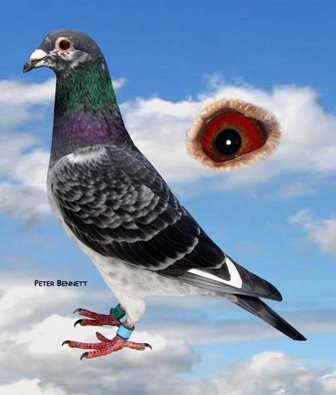
A
pigeon brought Noah the news that heralded the end of the great flood.
A
pigeon brought Noah the news that heralded the end of the great flood.
Figure
1: The dove was sent forth from the Ark to find evidence that the
waters of the universal flood were receding. The olive branch which the
dove carried in its beak was good news for all of us!
A pigeon
was the form taken by the Holy Ghost at the baptism of Jesus Christ, King
of Kings, by St. John The Baptist.
 Figure
2: The Holy Ghost, the third person of the Blessed Trinity, has traditionally
been represented as a dove descending from heaven.
Figure
2: The Holy Ghost, the third person of the Blessed Trinity, has traditionally
been represented as a dove descending from heaven.
Pigeons
were involved in the building of great empires, the amassing of vast fortunes,
great sieges of important cities, the great communication routes of the east, the great wars of history, the opening
of important Olympic games, the feeding of entire countries or the duping
and undermining of entire peoples and civilizations together with the
undermining of science. It is this last point (the undermining of science)
that I intend to briefly comment upon in this short article.
I
am not a geneticist or biologist, nor ornithologist, or for that matter
scientist of any sort. I am but a life long breeder of pigeons. My day to
day occupation is that of an independent book publisher and my formal training
is in the field of history.
 Figure
3: "The Pigeon Guide," a recently published book
by Silvio Mattacchione & Co., covers all aspects of pigeon breeding and care
as well as a great number of photos of the many varieties of pigeons (racing,
performance and utility) that have been developed by pigeon fanciers
around the world.
In
a very real sense I am probably (that is my pigeon breeding self) the
type of person that Darwin
sought out, listened to, discussed with and learned from in order to better
focus his own evolving ideas.
I
can still remember, when I was quite young, possibly in the fourth grade,
circa 1960, when I heard the term
"evolution" for the first time followed by the
name of its co-founder "Darwin." I had arrived in Canada in
1956, everything was so strange, a new country, new peoples, new ways, new
foods, new language, change was everywhere, it was in fact the order of
the day. For that matter the only
constant in the lives of most people today is "constant change."
When I told
my father what I had just learned he scoffed and quickly set me straight
on Mr. Darwin and his ideas. The concept of "molecule to man" was really
quite a remarkable stretch of the imagination. The product no doubt, of
a very fertile mind. Still what did my immigrant dad know compared to
all my new teachers, the new TV, the newspapers and books...oh so many
books? I was really intrigued with Darwin and his theory.
After all to that 4th grader Darwin was a pigeon fancier, albeit
a novice.
Figure
3: "The Pigeon Guide," a recently published book
by Silvio Mattacchione & Co., covers all aspects of pigeon breeding and care
as well as a great number of photos of the many varieties of pigeons (racing,
performance and utility) that have been developed by pigeon fanciers
around the world.
In
a very real sense I am probably (that is my pigeon breeding self) the
type of person that Darwin
sought out, listened to, discussed with and learned from in order to better
focus his own evolving ideas.
I
can still remember, when I was quite young, possibly in the fourth grade,
circa 1960, when I heard the term
"evolution" for the first time followed by the
name of its co-founder "Darwin." I had arrived in Canada in
1956, everything was so strange, a new country, new peoples, new ways, new
foods, new language, change was everywhere, it was in fact the order of
the day. For that matter the only
constant in the lives of most people today is "constant change."
When I told
my father what I had just learned he scoffed and quickly set me straight
on Mr. Darwin and his ideas. The concept of "molecule to man" was really
quite a remarkable stretch of the imagination. The product no doubt, of
a very fertile mind. Still what did my immigrant dad know compared to
all my new teachers, the new TV, the newspapers and books...oh so many
books? I was really intrigued with Darwin and his theory.
After all to that 4th grader Darwin was a pigeon fancier, albeit
a novice.
 Figure
4: Photo Of Darwin in later life together
with an image of his "The Origin of Species." This image was taken
from a site entitled www.btinternet.com/~glynhughes/
squashed/darwin.htm and is used with permission. Most people are unaware that Darwin
offered as its subtitle "The Preservation Of Favoured Races In The Struggle
For Life."
I was fascinated
by pigeons and Darwin
was equally fascinated by and studied pigeons. Darwin could have studied
anything, but he had determined to study a special group of birds and
that special group of birds was in fact the pigeon. Here is what he had
to say:
"Believing
that it is always best to study some special group, I have joined two of
the London
Pigeon Clubs. The diversity of the breeds is something astonishing. The
short-faced tumbler has a beak like a finch; the runt is a bird of great
size; the turbit has a line of reversed feathers down the breast. The Jacobin
has a hood on the back. The fantail has thirty or forty tail-feathers, instead
of the usual twelve or fourteen. Such are the variations that an ornithologist
would certainly rank them as well-defined species. Yet I am fully convinced
that the common opinion of naturalists is correct, namely, that all have
descended from the wild rock-pigeon (Columba livia)."
Figure
4: Photo Of Darwin in later life together
with an image of his "The Origin of Species." This image was taken
from a site entitled www.btinternet.com/~glynhughes/
squashed/darwin.htm and is used with permission. Most people are unaware that Darwin
offered as its subtitle "The Preservation Of Favoured Races In The Struggle
For Life."
I was fascinated
by pigeons and Darwin
was equally fascinated by and studied pigeons. Darwin could have studied
anything, but he had determined to study a special group of birds and
that special group of birds was in fact the pigeon. Here is what he had
to say:
"Believing
that it is always best to study some special group, I have joined two of
the London
Pigeon Clubs. The diversity of the breeds is something astonishing. The
short-faced tumbler has a beak like a finch; the runt is a bird of great
size; the turbit has a line of reversed feathers down the breast. The Jacobin
has a hood on the back. The fantail has thirty or forty tail-feathers, instead
of the usual twelve or fourteen. Such are the variations that an ornithologist
would certainly rank them as well-defined species. Yet I am fully convinced
that the common opinion of naturalists is correct, namely, that all have
descended from the wild rock-pigeon (Columba livia)." [
1]
As I was
growing up, I daily enjoyed observing my pigeons, (in my back yard in Toronto, in the early
60's) and Darwin had observed
pigeons at his home in the UK, as well
as at the homes of so many famous British fanciers of the 19th
century.
 Figure
5: Highly developed show specimen "Blue Vision" known as a British Show Racer,
bred and perfected by many including by author, stockman, Douglas McLeary
of the UK.
Show Racers, though beautiful to look at, were never developed to endure
or achieve the performance levels required of Racing Pigeons.
Figure
5: Highly developed show specimen "Blue Vision" known as a British Show Racer,
bred and perfected by many including by author, stockman, Douglas McLeary
of the UK.
Show Racers, though beautiful to look at, were never developed to endure
or achieve the performance levels required of Racing Pigeons.
His
supposed understanding of the pigeon amongst other forms ultimately led
to the formulation of a theory so powerful that we are still suffering
from its effects a century and a half later. He was to convince himself
that selection, eventually to be referred to as "Natural Selection" was
the primordial engine by which all life was to forever move from lesser
forms to higher forms, from less complicated to always more refined, more
adapted and more complicated forms. The pinnacle of this process culminating
in man himself! Here, in his own words, is the essence of his belief and
hypothesis:
"Such variability
may be attributed to the conditions of life, to use and disuse. But I am
convinced that Selection is by far the predominant Power." [2]
Today,
the mantra of evolution is heard everywhere, repeated everywhere, (in
the home, at the schools, in the churches and in the parliaments of the
world). Yet clearly it is understood by virtually no one and misunderstood
by virtually everyone!
 Figure
6:
Specialist pigeon fanciers in New York have spent the last half of the 20th century perfecting
the finer qualities of the USA variety
known as the "Flight." Photo courtesy of Ronda Mariani.
Figure
6:
Specialist pigeon fanciers in New York have spent the last half of the 20th century perfecting
the finer qualities of the USA variety
known as the "Flight." Photo courtesy of Ronda Mariani.
It certainly
seems to me that Darwin's work itself has been subject to this supposed
evolution, for it (Darwin's work) began as a hypothesis, then quickly evolved
into a theory, and with the passage of only a brief
amount of additional time emerged fully mutated into an entity more akin
to a religion than to science. A pseudo religion, in many cases a type of
state religion, a religion of the supposed enlightened. Oddly enough in
the 21st Century science itself has taken a back seat to this
new, politically correct religion! Evolution - religion for those who have
freed themselves permanently of all need of religion. How very odd yet here
is what was written of "Darwin's
dangerous idea"...
"This
is what Daniel Dennett called 'Darwin's dangerous idea' - that natural selection
can be seen as governing, not only the world's flora and fauna, but even
its history, its economics and its ideas. Even religious ideas, it seems,
are subject to the same laws of advancement as all other things,
"multiply, vary, let the strongest live and the weakest die."
[
3]
 Figure
7: "Medallion Cock" a
Champion British Show Racer bred by Douglas McLeary of the UK. It takes
great ability to maintain this level of quality consistently. These birds
reflect the artistic and creative abilities of the pigeon fanciers who perfected
them as a unique variety. An artist is limited to creating two dimensional
art on canvas whereas a truly dedicated pigeon fancier is interested in
creating living art! It was once thought that there were some 3-400 varieties
of pigeons however with the opening up of Eastern Europe and China that number could possibly double!
Figure
7: "Medallion Cock" a
Champion British Show Racer bred by Douglas McLeary of the UK. It takes
great ability to maintain this level of quality consistently. These birds
reflect the artistic and creative abilities of the pigeon fanciers who perfected
them as a unique variety. An artist is limited to creating two dimensional
art on canvas whereas a truly dedicated pigeon fancier is interested in
creating living art! It was once thought that there were some 3-400 varieties
of pigeons however with the opening up of Eastern Europe and China that number could possibly double!
I have read many articles by pigeon enthusiasts that often make reference
to Darwin
and evolution. Many talk of how the pigeon has evolved and how it is still
evolving. It would seem to me, if this were in fact a truth, that
such knowledge, in the hands of really dedicated pigeon breeders would be
an awesome (awesome power in the sense of what a pigeon breeder could achieve
in transforming his charges) power. Yet for the 41 years that I have bred
the racing (as well as other pigeons) I find my experience as a breeder
of animals, and my observations at constant odds with all that Darwin wrote
and imagined.
When you
choose to breed animals, any animals and certainly when you have done
so for as many years as I have, you begin to come to certain conclusions,
regardless of what has or has not been postulated or hypothesized. In
time I would come to write the following from my observations (which appeared
in racing pigeon publications worldwide) and my hands on experience, with
breeding pigeons (but certainly totally applicable to any animal or plant
form):
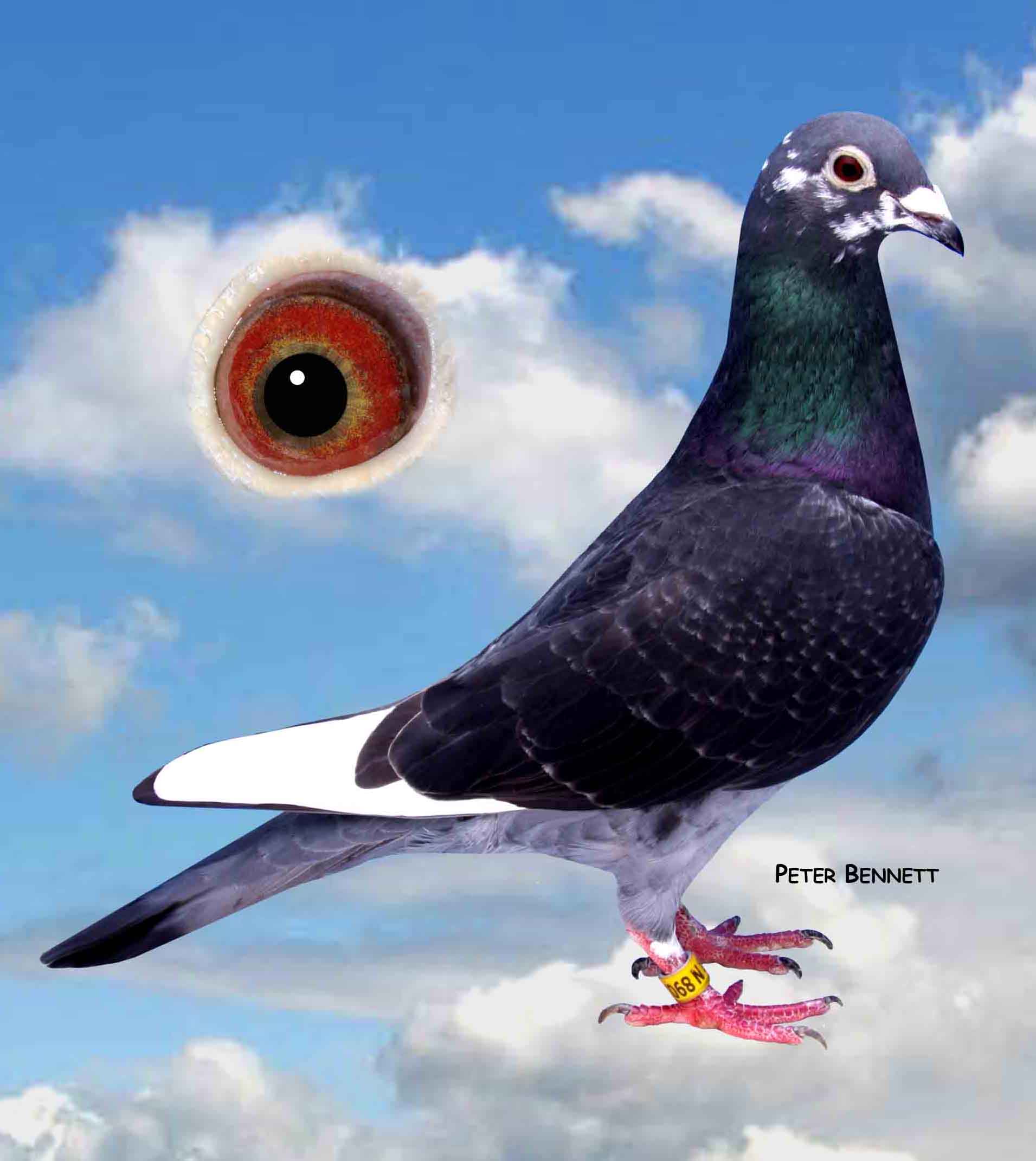
 Figure
8: The racing pigeon, as we now know
it, is the result of two centuries of total dedication to selective breeding
on the part of racing pigeon fanciers. The modern racing pigeon breeds
true but it is a hybrid that combined the best qualities of many different
pigeon varieties. The careful combination of the finest qualities of all
of these different varieties resulted in a highly developed homing instinct,
aerodynamic body, tremendous heart (nearly twice the size of a regular
pigeon's heart) and indestructible constitution, making the racing pigeon
the ultimate flying machine. Pictured above is "Phar Lap" a great-great
grandson of St. Thomas, bred by Silvio
Mattacchione, in 1997. Phar Lap was the Kwartha Northshore Combine Champion
as well as The Oshawa Racing Pigeon Club Old Bird Champion for 1998. He
flew 4,500 kilometers in 10 weeks.
Figure
8: The racing pigeon, as we now know
it, is the result of two centuries of total dedication to selective breeding
on the part of racing pigeon fanciers. The modern racing pigeon breeds
true but it is a hybrid that combined the best qualities of many different
pigeon varieties. The careful combination of the finest qualities of all
of these different varieties resulted in a highly developed homing instinct,
aerodynamic body, tremendous heart (nearly twice the size of a regular
pigeon's heart) and indestructible constitution, making the racing pigeon
the ultimate flying machine. Pictured above is "Phar Lap" a great-great
grandson of St. Thomas, bred by Silvio
Mattacchione, in 1997. Phar Lap was the Kwartha Northshore Combine Champion
as well as The Oshawa Racing Pigeon Club Old Bird Champion for 1998. He
flew 4,500 kilometers in 10 weeks.
"If
you wish to breed good pigeons, or good animals of any kind, you must
come to truly understand this simple truth. What truth? Well, the simple
truth is that Nature abhors order. Nature is the great equalizer; Nature
does not willingly admit of extremes. Left to herself, Nature reverts
to the common form. Nature never progresses from less order to greater
order, but always from order to disorder if left to her designs.
Most current
livestock survive in the form in which they exist because they are beneficial
to man in that form. They exist in that form because expert herdsmen (or
geneticists, scientists, and others) have applied known genetic principles
to common stock so as to modify them to their own ends, i.e., more milk,
more meat, more eggs, faster horse, and so on. If man took himself out
of the equation, the result would be a reversion or extinction of the
form." [
4]
Without really
knowing it, nor having studied it , my experience with breeding the racing
pigeon, had lead me to enunciated, in my own words, a well know universal
law of science. That is the second law of thermodynamics often called the
law of entropy!
 Figure
9: This exceptional variety
know as a "Satinette" has required tremendous work in developing
the incredibly complicated features of the head and beak. Someone, a fancier,
had a vision, clarified it in his own mind, prepared drawings of what his mind's eye saw and then spent his
entire life working out hundreds
and possibly thousands of breedings in an attempt to achieve the standard
that he envisioned. Most often these works of art are established over
many generations of pigeon fanciers. Photo courtesy of Ronda Mariani.
Figure
9: This exceptional variety
know as a "Satinette" has required tremendous work in developing
the incredibly complicated features of the head and beak. Someone, a fancier,
had a vision, clarified it in his own mind, prepared drawings of what his mind's eye saw and then spent his
entire life working out hundreds
and possibly thousands of breedings in an attempt to achieve the standard
that he envisioned. Most often these works of art are established over
many generations of pigeon fanciers. Photo courtesy of Ronda Mariani.
"Regarding
the second law of thermodynamics (universally accepted scientific law which
states that all things left to themselves will tend to run down) or the
law of entropy, it is observed, "It would hardly be possible to conceive
of two more completely opposite principles than this principle of entropy
increase and the principle of evolution. Each is precisely the converse
of the other. As (Aldous) Huxley defined it, evolution involves a continual
increase of order, of organization, of size, of complexity. It seems
axiomatic that both cannot possibly be true. But there is no question whatever
that the second law of thermodynamics is true." [5]
It is further
worthy of note that these two universal laws (the 1st and 2nd
laws of thermodynamics) are based upon literally thousands of scientific
experiments, with no known exceptions.
Figure 10: "Limited Edition" has
bred over 23 sons and daughters to win 1st place. A unique racing pigeon
specimen. He traces in a direct male line from the line of the "Oude Mercke."
He is very pre-potent and it seems that he has a
very rare ability to pass his qualities on to his offspring. His ability
to pass his genetic code seemingly un-adulterated is not the norm. Owned
by Silvio Mattacchione and Jim McLean.
"These laws
state that any natural process would involve conservation (1st law) and
disintegration (2nd law). Evolution demands "integration and development"
and is therefore impossible." [6]
What has
happened to and in the minds of people, of all levels, of all disciplines,
is that they can no longer understand that "truth can never be in contradiction
to truth." I remember well the words of David Goldstein LL.D. in a series
of letters he wrote in 1943 where he said as follows:
"Although
faith is above reason, there can never be disagreement between faith and
reason, because the same God who has revealed the mysteries and communicated
faith, has also given to the human mind the natural light of reason, and
we know that God cannot contradict Himself, nor can truth ever be in contradiction
with truth. Not only can faith and reason never be in discord, but they
lend each other mutual help; right reason demonstrates the foundation of
faith, and enlightened by the light of faith, it develops the science of
divine things; faith , on the other hand, frees and protects reason from
error and enriches it with knowledge of many kinds. The Church, therefore,
far from being opposed to the study of the arts and sciences, favors these
studies and propagates them in a thousand ways." [7]
In
the face of these two universal laws why is it that evolution is taught
to our children as fact? Certainly it makes no scientific sense. If not
science then what? Well the answer certainly seems to be summed up nicely
in the following quotation from D.M.S.Watson:
"Evolution
itself is accepted by zoologists, not because it has been observed to occur
or can be proved by logical coherent evidence, but because the only alternative
-- special creation -- is clearly incredible." [8]
Figure 11: Creation Of
Man by Michelangelo Buonarroti, 1511-1512
fresco located in the Sistine Chapel, Vatican City, Rome, Italy. Image from
www.mystudios.com/.../michelangelo-creation-man.jpg
Darwin had every
reason to doubt his own work. He was constantly in a state of paranoia regards
the veracity of all of his conjectures. He was haunted by the fear that
he had in fact devoted his entire life to the creation of a fantasy! Darwin
was to write as follows: "I
have asked myself whether I may not have devoted my life to a fantasy."[9]
Figure 12: This show homer is prized for its great beauty. Work
is required on a continuous basis to maintain the special features of the
round head and beak. hen has I know
a squab breeder in Canada
who incorporates all kinds of unique elements both " crests and
unique color varieties" to maintain his interest and stave off boredom. If you have, patience , time and a vision of
a new pigeon variety and you are
dedicated to its development you can achieve your goal. Photo courtesy of
Ronda Mariani.
What
does all of this really mean? Well in simplest terms it certainly seems
to indicate that many scientists (geneticists, biologists, botanists,
zoologists, anthropologists, paleontologists, etc.) have chosen, for many
reasons (most of which have nothing to do with science) to close their
collective eyes to the immutable laws of science. In essence they choose
to survive in this politically correct, modern world. In most cases they
do what needs to be done. Educators, who have little or no expertise of
their own, in any of these areas but who, in many cases, are subject to
all of the same survival and promotional considerations as the scientists
in question, just do their jobs. Children world wide walk away dazed and
confused. Little wonder then what we currently see around us.
W.R.Thompson,
who is certainly pro-evolution, in his introduction to Origin of Species
by Darwin, (page 90) had the following observation to make:
"This
situation, where men rally to the defense of a doctrine they are unable
to define scientifically, much less demonstrate with scientific rigor,
attempting to maintain its credit with the public by the suppression of
criticism and the elimination of difficulties, is abnormal and undesirable
in science."[10]
What
have I learned as a stockman? I know for a fact that no biologist can
give any evidence that shows that any species has evolved from another.
I know through observation that new varieties of plants can and are developed,
as are new varieties of animals but this process cannot in any way be
referred to as evolution. Yet clearly Darwin
(was?) seemed to be confused (willingly so?) by this very simple distinction.
He glossed over it, confused it, made light of it and sought to even have
it prove what any novice stock breeder knew intuitively and that is that
variety and species were fundamentally of a different order. Here is what
Darwin had to say in his Chapter
VIII on Hybridism in his "Origin
of Species":
"Finally,
then, the facts briefly given in this chapter do not seem to me opposed
to, but even rather to support the view, that there is no fundamental distinction
between species and varieties." [11]
Figure
13: Head shot of the "long faced tumbler" as you
compare each of the head shots in this article you can begin to imagine
the incredible work , patience and dedication that it requires on the
part of large numbers of fanciers, over many generations, to both perfect
and then maintain these incredible varieties over so many countless generations.
Some varieties are centuries old, some have been with us since the time
of biblical man! Photo courtesy of Ronda Mariani.